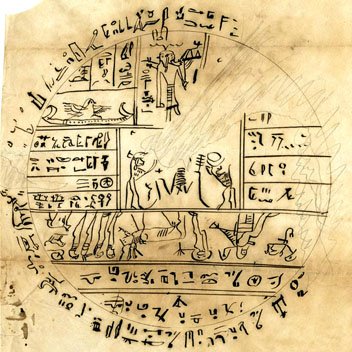
The source of Facsimile 2 is a Hypocephalus, which is laid under the head of the deceased, Sheshonq.
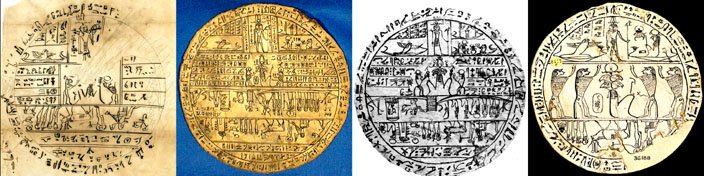
Common Egyptian Hypocephali
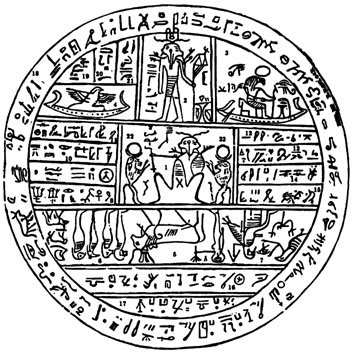
- The original hypocephalus is lost. An early rendering of it reveals damage. Egyptologists agree that the published Facsimile 2 is a poor and inaccurate restoration.
| Source Papyrus Sheshonq Hypocephalus |
Book of Abraham Facsimile 2 |
|---|---|
 |
 |
Verifying Joseph's Translation
| Figure | Joseph Smith | Egyptology |
|---|---|---|
| 1 | Kolob, signifying the first creation, nearest to the celestial, or the residence of God. First in government, the last pertaining to the measurement of time. The measurement according to celestial time, which celestial time signifies one day to a cubit. One day in Kolob is equal to a thousand years according to the measurement of this earth, which is called by the Egyptians Jah-oh-eh. | The Egyptian god Khnumu. |
| 2 | Stands next to Kolob, called by the Egyptians Oliblish, which is the next grand governing creation near to the celestial or the place where God resides; holding the key of power also, pertaining to other planets; as revealed from God to Abraham, as he offered sacrifice upon an altar, which he had built unto the Lord. | The Egyptian god Amen-Re. |
| 3 | Is made to represent God, sitting upon his throne, clothed with power and authority; with a crown of eternal light upon his head; representing also the grand Key-words of the Holy Priesthood, as revealed to Adam in the Garden of Eden, as also to Seth, Noah, Melchizedek, Abraham, and all to whom the Priesthood was revealed. | The Egyptian god Horus-Re in a boat. |
| 4 | Answers to the Hebrew word Raukeeyang, signifying expanse, or the firmament of the heavens; also a numerical figure, in Egyptian signifying one thousand; answering to the measuring of the time of Oliblish, which is equal with Kolob in its revolution and in its measuring of time. | The Egyptian god Sokar. |
| 5 | Is called in Egyptian Enish-go-on-dosh; this is one of the governing planets also, and is said by the Egyptians to be the Sun, and to borrow its light from Kolob through the medium of Kae-evanrash, which is the grand Key, or, in other words, the governing power, which governs fifteen other fixed planets or stars, as also Floeese or the Moon, the Earth and the Sun in their annual revolutions. This planet receives its power through the medium of Kli-flos-is-es, or Hah-ko-kau-beam, the stars represented by numbers 22 and 23, receiving light from the revolutions of Kolob. | The cow of Hathor and behind it a goddess holding a tree. |
| 6 | Represents this earth in its four quarters. | The four sons of Horus: Imsety, Hapy, Duamutef, and Qebehsenuef. |
| 7 | Represents God sitting upon his throne, revealing through the heavens the grand Key-words of the Priesthood; as, also, the sign of the Holy Ghost unto Abraham, in the form of a dove. | The Egyptian god Min (sitting) and Atum (a snake). |
| 8-22 | No interpretations provided |